
Ozempic’s Hidden Power: How GLP-1 Drugs Quietly Cut Addiction

📑 Table of Contents
Ozempic’s Hidden Power: How GLP-1 Drugs Are Quietly Treating Addiction
If you’ve spent any time on health TikTok or wellness Twitter lately, you’ve probably noticed a strange new pattern. People taking Ozempic, Wegovy, and Mounjaro for weight loss or diabetes keep reporting something unexpected: they don’t just crave food less. They also report drinking less, smoking less, and feeling generally less compelled by their old habits. Some say their alcohol cravings disappeared almost entirely. A few have described going off opioids with surprising ease.
For years, the medical community treated these reports as interesting anecdotes. But in the last 18 months, a wave of peer-reviewed studies has started to confirm what patients have been saying, putting GLP-1 drugs addiction research at the center of one of the most surprising new stories in modern medicine. GLP-1 receptor agonists — the drug class behind Ozempic and Wegovy — appear to do far more than shrink your appetite. New evidence suggests they may also reduce the risk of alcohol use disorder, opioid overdose, nicotine addiction, and even drug-related death.
In this post, we’ll walk through what the research actually shows. We’ll look at the landmark 2026 Lancet trial, a 600,000-person Veterans Affairs study, and several other peer-reviewed papers. We’ll also cover how these drugs might work, what the limitations are, and what it means for you.
A note on how this topic was chosen: When we ran our regular health trends research for Trijal Vitality, the Google Trends data for the week showed a striking cluster — five of the top 25 trending health queries were about weight loss medications (weight loss medication, weight loss pills, medical weight loss, weight loss clinic, and tirzepatide). On the same day, our RSS health news feed picked up a fresh lead: a study reporting that GLP-1 weight loss drugs were linked to lower risks of addiction and overdose. The two signals together pointed to the topic you’re reading about now — the surprising crossover between America’s fastest-growing drug class and one of its oldest public health crises.

What Are GLP-1 Drugs and Why Are They Linked to Addiction?
GLP-1 receptor agonists are a class of medications originally developed for type 2 diabetes. Related: Flush Liver Fat Fast: My Journey to a Healthier Liver in 2025 They mimic a gut hormone called glucagon-like peptide-1, which slows digestion, blunts appetite, and helps regulate blood sugar. The most prescribed versions today are semaglutide (sold as Ozempic for diabetes and Wegovy for weight loss) and tirzepatide (sold as Mounjaro and Zepbound).
These drugs have become cultural phenomena. Tens of millions of prescriptions are written each year, and the demand has often outstripped supply. As more people started taking them, the reports of “side benefits” began piling up. People said their desire to drink wine with dinner vanished. Smokers said cigarettes started tasting strange. A few patients recovering from opioid use disorder said the drug seemed to quiet the background hum of craving.
If you’re new to the weight-loss-drug conversation and want a primer on how prescription drugs compare to food-first approaches, our guide to foods that support belly-fat loss is a good starting point. For context on the metabolic inflammation connection, see our anti-inflammatory diet guide — chronic inflammation is one of the shared mechanisms researchers are now exploring for both obesity and addiction.
Researchers paid attention. The brain circuits that drive food cravings and the brain circuits that drive addiction overlap heavily — both involve the mesolimbic dopamine reward system. So if a drug quiets one set of cravings, it might quiet the other too. By 2024, this hypothesis moved from speculation to serious science.
The Landmark 2026 Lancet Trial
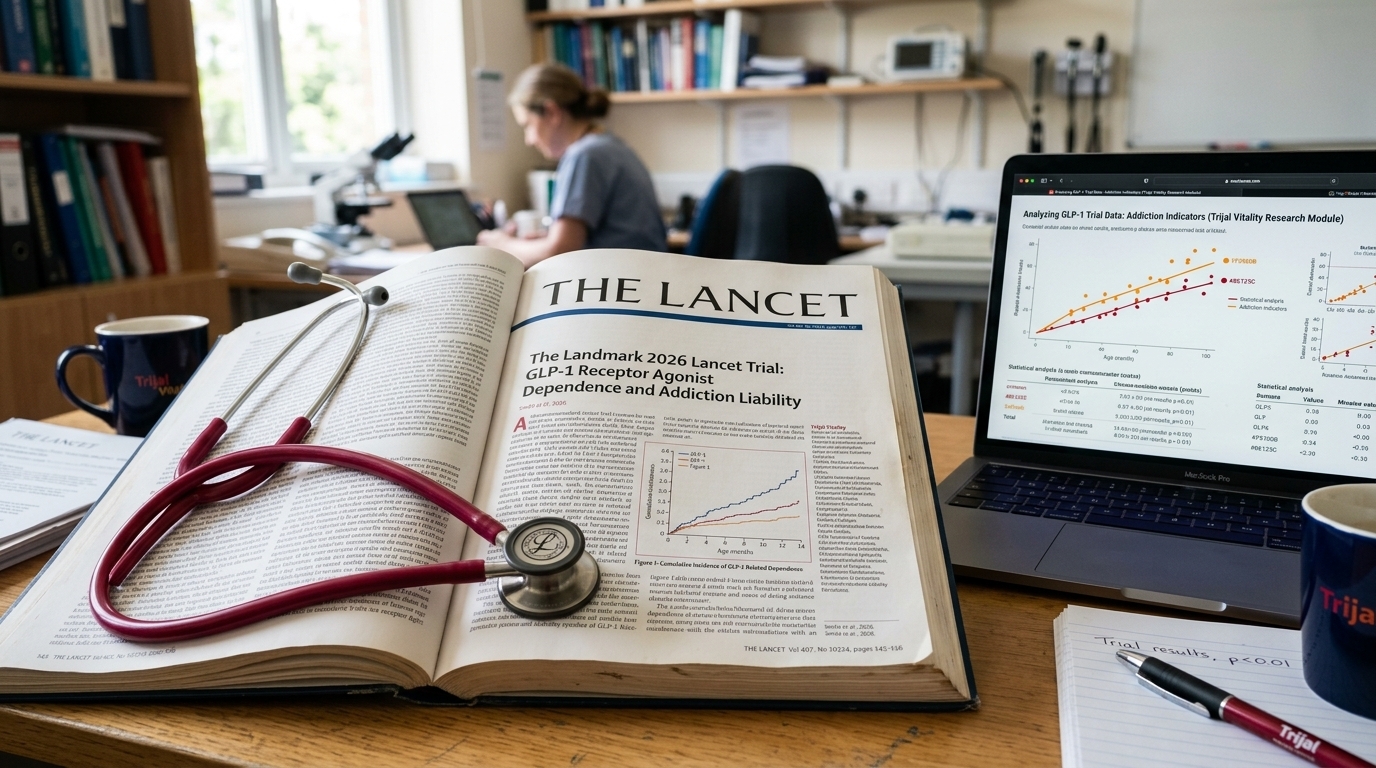
The most important new study was published in The Lancet on May 2, 2026. It’s the first large, well-designed randomized controlled trial to test semaglutide specifically as a treatment for alcohol use disorder.
In the trial, 108 treatment-seeking adults with moderate-to-severe alcohol use disorder and comorbid obesity were split into two groups. Half received once-weekly semaglutide injections (titrated up to 2.4 mg, the same dose used for weight loss) plus standard cognitive behavioral therapy. The other half received placebo injections plus the same therapy. The trial ran for 26 weeks.
The results were striking. The semaglutide group reduced their heavy drinking days by 41.1 percentage points from baseline, compared to 26.4 percentage points in the placebo group. The treatment difference of 13.7 percentage points was statistically significant (p=0.0015). In other words, the people on semaglutide had substantially fewer days of heavy drinking than the people on placebo, on top of the benefits both groups got from therapy.
Adverse effects were mild and expected — mostly transient nausea and other gastrointestinal symptoms, which are well-known with this drug class. Eighty-one percent of participants completed the full trial, which is high for an addiction study.
The authors concluded that semaglutide “showed robust therapeutic effects in treatment-seeking participants with obesity and alcohol use disorder” and called it a “potential novel treatment target” for AUD. 1
The 600,000-Person Veterans Affairs Study
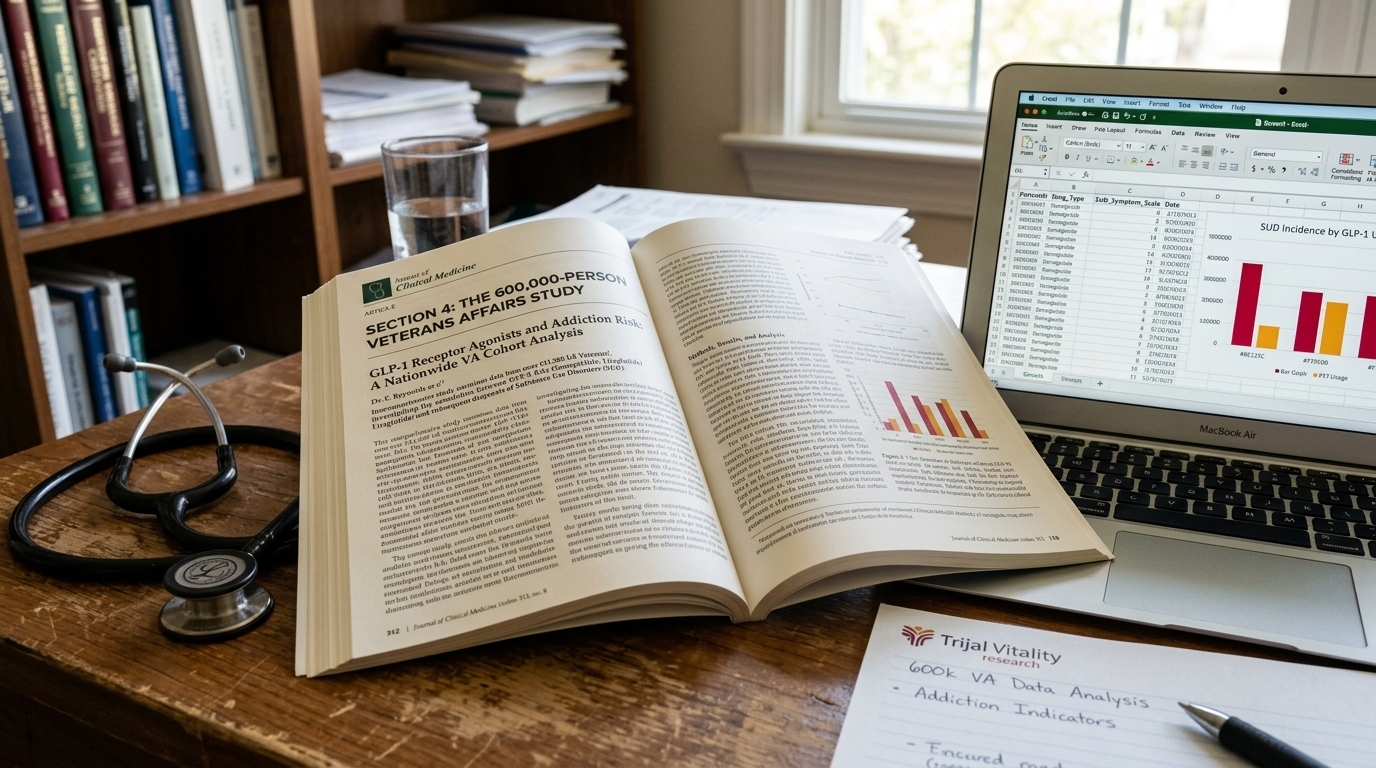
A separate study, published in The BMJ in March 2026, took a much broader look. Researchers at Washington University in St. Louis analyzed anonymized health records from 606,434 U.S. veterans with type 2 diabetes. They compared people who started a GLP-1 drug to people who started a different diabetes drug (an SGLT-2 inhibitor), tracking them for a median of three years.
The results covered every major substance class:
- Alcohol use disorder risk dropped 18% (hazard ratio 0.82)
- Cannabis use disorder risk dropped 14% (HR 0.86)
- Cocaine use disorder risk dropped 20% (HR 0.80)
- Nicotine use disorder risk dropped 20% (HR 0.80)
- Opioid use disorder risk dropped 25% (HR 0.75)
Translated into real numbers, that’s roughly seven fewer new substance use disorder diagnoses for every 1,000 people taking a GLP-1 drug compared to a non-GLP-1 diabetes drug over three years. 2
But the second part of the study may matter even more. Among veterans who already had a substance use disorder at baseline, starting a GLP-1 drug was associated with dramatic drops in serious harm:
- 31% fewer emergency department visits related to substance use
- 26% fewer hospital admissions related to substance use
- 39% fewer overdoses
- 50% fewer drug-related deaths
That translates to about 12 fewer serious harm events per 1,000 GLP-1 users over three years. For context, 50% fewer drug-related deaths is a larger effect than most addiction medications on the market today have ever shown. 3
What the Research Shows for Each Substance
| Substance | Best Evidence | Key Effect Size | Source |
|---|---|---|---|
| Alcohol | Lancet RCT (2026) | -13.7 pp heavy drinking days | Klausen et al., Lancet 2026 |
| Alcohol | Nature Communications (2024) | 50-56% lower AUD risk | Wang et al., Nat Commun 2024 |
| Alcohol | JAMA Psychiatry (2024) | 36% lower AUD hospitalization (aHR 0.64) | Lähteenvuo et al., JAMA Psych 2024 |
| Alcohol | JAMA Psychiatry RCT (2025) | Reduced lab self-administration, reduced craving | Hendershot et al., JAMA Psych 2025 |
| Opioids | BMJ VA study (2026) | 25% lower OUD incidence; 39% fewer overdoses | Xie et al., BMJ 2026 |
| Opioids | PMC cohort (2024) | HR 0.32-0.58 for opioid overdose | Wang et al., JAMA Netw Open 2024 |
| Cannabis | Molecular Psychiatry (2024) | 44% lower incident CUD (HR 0.56) | Wang et al., Mol Psych 2024 |
| Nicotine | BMJ VA study (2026) | 20% lower nicotine use disorder | Xie et al., BMJ 2026 |
| Stimulants (cocaine) | BMJ VA study (2026) | 20% lower cocaine use disorder | Xie et al., BMJ 2026 |
Across the board, the pattern is consistent: GLP-1 drugs are associated with lower rates of developing a substance use disorder, and for people who already have one, lower rates of serious harm like overdose and death. 4
How Might GLP-1 Drugs Reduce Cravings?
Researchers have proposed several mechanisms, and the truth is probably a combination of all of them.
The brain reward circuit. GLP-1 receptors exist throughout the brain, including in the ventral tegmental area and nucleus accumbens — the two main hubs of the mesolimbic dopamine system. This is the same circuit that lights up when you eat, drink alcohol, take opioids, or use nicotine. Animal studies show that GLP-1 agonists directly reduce dopamine release in this circuit in response to drugs of abuse. 5
A “food and drug satiety” effect. Patients often describe the experience not as craving being blocked, but as cravings simply losing their grip. The mental chatter quiets down. This is consistent with how the drugs work on food — they don’t make food taste bad, they just take the urgency out of wanting it.
Reduced impulsivity. Some evidence suggests GLP-1 drugs may improve executive function and reduce impulsive decision-making, which is a known contributor to relapse in addiction.
Indirect effects. People on GLP-1 drugs often lose 10-20% of their body weight, see inflammation markers drop, and report better sleep. All of these changes independently improve mental health and reduce substance use risk. So some of the benefit may be downstream of metabolic improvement, not direct brain action.
What Researchers Are Still Unsure About
This research is genuinely exciting, but it’s not the final word. Here are the important caveats.
Most evidence is observational. The big BMJ study and the JAMA Psychiatry study from Sweden both analyzed existing health records. They used careful statistical methods to match groups, but they can’t prove that GLP-1 drugs caused the reductions. There could be unmeasured factors — for example, people who can afford and access GLP-1 drugs may have other advantages that affect substance use.
The randomized trials are still small. The 2026 Lancet trial is the gold standard, but 108 people is a modest sample. Several larger trials are now recruiting, including studies specifically testing GLP-1 drugs for opioid use disorder.
The effect is strongest in people with obesity or diabetes. Many of these studies were done in patients who had metabolic disease to begin with. It’s not yet clear if the same effects show up in people who are at a healthy weight or who don’t have diabetes.
These drugs are not a magic bullet. The Lancet trial participants also received cognitive behavioral therapy. GLP-1 drugs likely work best as part of a broader treatment plan, not as a stand-alone cure.
Side effects are real. Nausea, vomiting, diarrhea, and constipation are common, especially during the dose-escalation phase. There’s also been ongoing scrutiny of rare but serious side effects like pancreatitis and gastroparesis. Most people tolerate the drugs well, but they’re not risk-free.
Practical Takeaways
So what should you do with this information?
If you’re already taking a GLP-1 drug for diabetes or weight loss and you’ve noticed your alcohol cravings fading or your smoking habit slipping away — you’re not imagining it. The pattern you’re experiencing is now backed by solid observational data and a randomized trial. It’s worth mentioning it to your doctor, especially if you’re in recovery from a substance use disorder.
If you have a substance use disorder and you’re not currently on a GLP-1 drug, don’t try to obtain one off-label on your own. Talk to your doctor. The evidence is strong enough that it’s reasonable to have the conversation, but these drugs require a prescription, monitoring, and a careful dose titration. The ongoing clinical trials may be a way to access them under medical supervision for addiction specifically.
If you’re a clinician or researcher, the field is moving fast. Keep an eye on ClinicalTrials.gov for the next wave of RCTs, including opioid use disorder trials, larger AUD trials, and head-to-head comparisons with existing addiction medications like naltrexone and buprenorphine.
If you simply find this science fascinating — welcome to one of the most exciting developments in addiction medicine in decades. The fact that a drug designed for blood sugar might also save lives from overdose is a reminder that the human body still holds secrets we’re only beginning to understand.
If you’re considering a non-pharmaceutical path to better metabolic and mental health, our walking for weight loss guide covers the dose-response science in detail. For an authoritative overview of semaglutide itself — the compound, approved uses, and ongoing trials — the MedlinePlus drug information page is a trustworthy government-run reference.
Frequently Asked Questions
Do GLP-1 drugs really reduce alcohol cravings?
Yes, the evidence is now strong. A 2026 Lancet randomized trial of 108 adults with alcohol use disorder found that semaglutide reduced heavy drinking days by 13.7 percentage points more than placebo over 26 weeks. Several large observational studies have also found 18-50% lower rates of alcohol-related problems in people taking GLP-1 drugs. 12
Can Ozempic help with opioid addiction?
Early evidence suggests it may. A 2024 cohort study found semaglutide was associated with a 42-68% lower risk of opioid overdose in people with type 2 diabetes and opioid use disorder. A randomized trial testing semaglutide for opioid use disorder is currently underway. 6
Why would a weight loss drug affect drug cravings?
GLP-1 receptors are found throughout the brain’s reward circuit, including the mesolimbic dopamine pathway that drives both food and drug cravings. Animal studies show that activating these receptors reduces dopamine release in response to drugs of abuse. The same mechanism that quiets “food noise” appears to quiet other cravings too. 5
Are GLP-1 drugs FDA-approved for addiction?
Not yet. As of mid-2026, semaglutide and tirzepatide are FDA-approved for type 2 diabetes, weight loss, and (in some cases) cardiovascular risk reduction. Using them for addiction would be off-label. Clinical trials are underway that could lead to a future FDA-approved indication for alcohol or substance use disorder. 7
Should I ask my doctor about GLP-1 drugs for addiction?
If you have a substance use disorder, it’s a reasonable conversation to have — especially if you also have obesity, diabetes, or related metabolic conditions. Don’t try to obtain these drugs on your own, and don’t stop your current treatment plan. Bring the research to your appointment and discuss whether participating in a clinical trial might be appropriate for you.
Sources
Important Notice
The information in this article is provided for general educational and informational purposes only. Related: Eat These to Burn Belly Fat Like Crazy: 10 Proven Foods for a Flatter Stomach It is not medical advice, a clinical opinion, a substitute for diagnosis, or a treatment plan, and it does not create any patient–provider, doctor–patient, or therapeutic relationship between you and Trijal Vitality, its authors, or its contributors.
Nothing on this page should be interpreted as a recommendation to begin, stop, increase, decrease, or alter the dose of any prescription drug, over-the-counter medication, supplement, herbal product, alcohol, nicotine product, or other substance. Always consult a qualified, licensed healthcare professional — such as your primary care physician, a psychiatrist, an addiction-medicine specialist, or a registered pharmacist — before making any decision that could affect your health or the course of an existing treatment.
If you believe you may be experiencing a medical emergency, a mental-health crisis, or a substance-related overdose, call 911, go to the nearest emergency department, or contact your physician immediately. If you or someone you care about is struggling with substance use, free and confidential support is available 24 hours a day, 7 days a week through the SAMHSA National Helpline at 1-800-662-4357, or by visiting findtreatment.gov.
Trijal Vitality does not endorse, certify, or warrant the safety, effectiveness, or suitability of any specific product, therapy, brand, or protocol mentioned in this article. Drug names, brand names, and trademarks are the property of their respective owners and are used here for factual identification only. References to peer-reviewed studies are provided for transparency and reader verification; the inclusion of a citation does not constitute an endorsement of that study’s conclusions by Trijal Vitality.
This article may be updated as new evidence emerges. The “last updated” date at the top of the page reflects the most recent revision.
-
Klausen MK, et al. “Once-weekly semaglutide versus placebo in patients with alcohol use disorder and comorbid obesity: a randomised, double-blind, placebo-controlled trial.” The Lancet 407(10540):1687-1698, May 2, 2026. PMID: 42070571. https://pubmed.ncbi.nlm.nih.gov/42070571/ ↩↩
-
Xie Y, et al. “Glucagon-like peptide-1 receptor agonists and risk of substance use disorders among US veterans with type 2 diabetes: cohort study.” The BMJ 392, March 4, 2026. https://www.bmj.com/content/392/bmj-2025-086886 ↩↩
-
Washington University School of Medicine news release. “GLP-1 medications get at the heart of addiction: study.” March 4, 2026. https://medicine.washu.edu/news/glp-1-medications-get-at-the-heart-of-addiction-study/ ↩
-
Wang W, Volkow ND, Berger NA, et al. “Associations of semaglutide with incidence and recurrence of alcohol use disorder in real-world population.” Nature Communications 15:4548, May 28, 2024. https://www.nature.com/articles/s41467-024-48780-6 ↩
-
Farokhnia M, et al. “Glucagon-like peptide-1 receptor agonists, but not dipeptidyl peptidase-4 inhibitors, reduce alcohol intake.” Journal of Clinical Investigation, March 6, 2025. https://www.jci.org/articles/view/188314 ↩↩
-
Wang W, et al. “Semaglutide and Opioid Overdose Risk in Patients With Type 2 Diabetes and Opioid Use Disorder.” JAMA Network Open, 2024. https://pmc.ncbi.nlm.nih.gov/articles/PMC11425147/ ↩
-
Lähteenvuo M, et al. “Repurposing Semaglutide and Liraglutide for Alcohol Use Disorder.” JAMA Psychiatry 82(1):94-98, November 13, 2024. https://jamanetwork.com/journals/jamapsychiatry/fullarticle/2825650 ↩

Leave a Reply